


A crack can propagate through a material because of the concentration of stress at its tip, where the forces acting on the material are magnified. The propagation of a crack depends on the interaction between the applied load, material properties, and the size and shape of the crack.
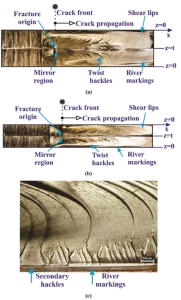
Reasons Why a Crack Propagates:
- Stress Concentration:
- At the tip of a crack, stress is much higher than in the rest of the material due to the geometry of the crack.
- The stress intensity factor (K) describes the stress field near the crack tip, and when K exceeds the material’s fracture toughness (Kₐ), the crack will propagate.
- Energy Release Rate:
- A crack propagates when the energy released as the crack grows is greater than the energy required to create new surfaces.
- This is quantified by G, the strain energy release rate, and when G > Gₐ (material-specific threshold), crack growth occurs.
- Plastic Zone Formation:
- Near the crack tip, local plastic deformation may occur, which can weaken the material and allow the crack to extend.
- If the plastic zone becomes too large, the crack may transition from brittle fracture to ductile tearing.
- Material Properties:
- Materials with low fracture toughness (e.g., glass or ceramics) allow cracks to propagate easily.
- Metals, especially ductile ones, resist crack growth more effectively through plastic deformation.
- Modes of Loading:
Crack propagation can occur under different types of loading:- Mode I (Opening Mode): Tensile stress perpendicular to the crack surface.
- Mode II (Sliding Mode): Shear stress parallel to the crack front.
- Mode III (Tearing Mode): Shear stress perpendicular to the crack front.
- Environmental Factors:
- Environmental conditions like moisture or chemical exposure can weaken the crack tip through processes such as stress corrosion cracking or hydrogen embrittlement, accelerating propagation.
- Cyclic Loading (Fatigue):
- Repeated application of fluctuating loads can cause a crack to grow progressively, even if the stress levels are below the material’s ultimate tensile strength.
Visualizing the Process:
- Imagine stretching a material with a small defect. The forces acting on the defect’s tip are much higher than in the surrounding material. When these forces exceed the material’s ability to resist, the defect elongates into a crack and propagates further under continued load.
Key Prevention Strategies:
- Use materials with higher fracture toughness.
- Minimize initial defects or cracks during manufacturing.
- Use compressive residual stresses (e.g., shot peening) to counteract tensile stress at the surface.
- Avoid environments that promote crack growth, such as corrosive or high-humidity conditions.





comments (8)